 Maori
Leap Caves, Kaikoura, New Zealand.
Maori
Leap Caves, Kaikoura, New Zealand.
New Zealand cave spider.
 New Zealand cave spider
The New Zealand cave spider lives in semi-dark areas, close to the mouth of caves.
 Te Anaroa Caves.
 Come with us to an
underground hideaway of magnificent natural beauty.
An ancient place,
deep beneath the earth, where stalactites and stalagmites abound... You'll see fossilised shellfish
- the size they were, millions of years before humans discovered
the scallop pie!
You'll see fossilised shellfish
- the size they were, millions of years before humans discovered
the scallop pie!
Turn out the lights and gaze up at the roof of the cave far above...
There are Glow Worms, shining like stars overhead in a subterranean sky. Te Anaroa Caves Tour is
a safe and easy one-and-a-half hour underground adventure which
has delighted visitors of all ages for more than a hundred years.
Te Anaroa Caves Tour is
a safe and easy one-and-a-half hour underground adventure which
has delighted visitors of all ages for more than a hundred years.
We'll give you an informal and interesting guided tour as we journey together through 350 metres of spectacular ancient limestone formations.
 Admission:
 Ruatapu Cave Entrance Orakei Korako Taupo New Zealand
The entrance to the Ruatapu Cave/Aladdin's Cave at Orakei Korako near Taupo, New Zealand is an arched opening surrounded by various species of plant life. From the top of the cliff, the entrance to Ruatapu Cave is 120 feet down where visitors can explore the underground geothermal world.
This is one of two caves known throughout the world that exists in a geothermal field and before entering the Ruatapu Cave, there is a shallow pool of green water. This pool carries with it many different meanings, one being a magical place to make a wish.
Ruatapu Cave is a definite highlight at Oarkei Korako near Taupo, New Zealand and once passing through the entrance, a magical and peaceful feeling is apparent.
Entrance to Ruatapu Cave meaning Sacred Cave is also known as Aladdin's Cave at Orakei Korako, near Taupo, North Island, New Zealand.
 Pictured above are the first and second
caves which join. This allows you to enter one and exit through
the other as you choose. The inside ceiling of the first cave
reaches 30 metres in sections - making it a great place to test out your
singing voice.
Remember to look up as you enter and see
the definite cathedral shape. Cathedral Caves, Catlins, South Island, New Zealand.
Pictured above are the first and second
caves which join. This allows you to enter one and exit through
the other as you choose. The inside ceiling of the first cave
reaches 30 metres in sections - making it a great place to test out your
singing voice.
Remember to look up as you enter and see
the definite cathedral shape. Cathedral Caves, Catlins, South Island, New Zealand.
 The varied colours and rock formations
surround you - as you explore these natural wonders. Cathedral
Caves, Catlins, South Island, New Zealand.
The varied colours and rock formations
surround you - as you explore these natural wonders. Cathedral
Caves, Catlins, South Island, New Zealand.
 A torch can enhance your viewing inside the
caves. If you have a torch - bring it with you.
Cathedral Caves, Catlins, South Island, New Zealand.
A torch can enhance your viewing inside the
caves. If you have a torch - bring it with you.
Cathedral Caves, Catlins, South Island, New Zealand.
 Waipati Beach from inside the cave. Chaslands
Head in the distance. Cathedral Caves, Catlins, South Island, New Zealand.
Waipati Beach from inside the cave. Chaslands
Head in the distance. Cathedral Caves, Catlins, South Island, New Zealand.
 One of the many beautiful fairy-like caves on the Wanganui River, North Island, New Zealand.
 Limestone formations, Waiomio
The limestone formations are a striking feature of the landscape of Waiomio.
 Waiomio, Far North New Zealand
Limestone pillars in the bush of Kawhiti Caves.

 Kawhiti Caves, Waiomio
Kawhiti Caves, Waiomio stalagmite formation.
 Kawiti Caves, Waiomio
Kawiti Caves entrance.
General Information.
Waiomio is a small Māori settlement five mins drive from Kawakawa. Waiomio is the ancestral land and heart of the Ngati Hine people.The surrounding hills have many burial caves and their ancestor Hineamaru lies in a secret cave surrounded by her warriors on the property owned by the Kawiti whanau (family) and are the kiatiaki (guardians) of the Kawiti Glow Worm Caves on their property.
History.
The whanau are descendants of the Ngāti Hine chief Te Ruki Kawiti, a prominent Māori chieftain who not only fought successfully alongside Hone Heke but also designed the inaccessible inland site of Ruapekapeka (the bat's nest) pa. This extraordinary fortification, incorporated palisades, trenches, and underground shelters. In early 1846 it withstood two weeks of bombardment by British forces before its defences were breached. When the British finally entered they found only a handful of Māori still inside – the rest had strategically withdrawn. With restoration and interpretation, it is now an important historic site.
The Kawiti Glow Worm Caves.
Its main attraction is the Kawiti Glow Worm Caves. A small stream flows (pet eel included) through the limestone caverns that feature delicate stalactite and stalagmite formations. The glow worm (Pura Toke) grotto is quite spectacular and the guide’s narration is informative and humorous. On exiting the caves you walk through a serene native bush coexisting with the limestone pillars and boulders which took 1000 years to form. It is not unusual as you explore the surrounding for a surreal sense to touch you making you feel one with the land.
Ruatapu Cave Tourists Orakei Korako New Zealand
People make wishes everyday, but many tourists to Ruatapu Cave and the magical pool at Orakei Korako in Waikato on the North Island of New Zealand find these wishes really come true.
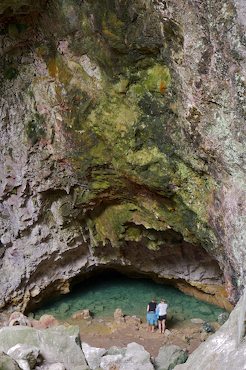
One of the great tourist attractions to see at Orakei Korako near Taupo, New Zealand is the Ruatapu Cave/Aladdin's Cave. The people at the base of the cave stand along the edge of the pool, a magical place known to make wishes come true when your left hand is placed in the water.
The pool was used by Maori people for washing as the warmth of the water made cleansing more enjoyable than using the colder waters of streams, lakes or rivers.
The Ruatapu Cave/Aladdin's Cave is 120 feet down where tourists can walk through the cave and explore the underground world of this geothermal area.
Ruatapu Cave meaning Sacred Cave is also known as Aladdin's Cave and Waiwhakaata (the pool) which means Pool of Mirrors at Orakei Korako, near Taupo, North Island, New Zealand.
Caves of Legend.
Sometimes we have glimpses into caves in the cliffs, overhung by drooping ferns and trailing forest-creepers and the ever-present bunches of hanging kiekic. Ruru-popo is one of these caves, a deep dark cavern on the riverside, proper right bank.
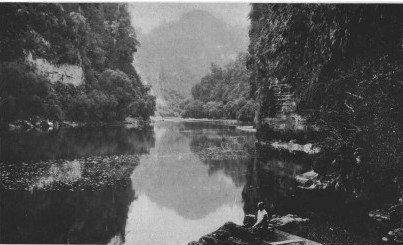
The enchanting “Drop Scene” on the world-famed Wanganui River, North Island, New Zealand.
Another cave on this same side is Puraroto, where once upon a time, according to Reone's legends, a fearsome taniwha, or man-devouring monster, had lived.
Yet another cave is a picture to entrance the eye and excite the imagination. It is on the east, or left bank, nearly opposite the Puraroto cave and stream. At the foot of a horseshoeshaped indent or recess in the precipice there is a little level spit, densely grown with plumey ferntrees, and behind is the ana, the cave. Over the rocky front of the cave fall two cascades, twin fountains of silver leaping out from unseen streams.
This singularly lovely spot—albeit an uncomfortably damp one— is called Tu-ka-iriao. It was one of the dwelling places of a small Maori tribe long ago. The rivermen's stockaded pa was on a terrace far above, and to this terrace the people climbed by rough ladders made of the vines of the aka, a tough forest creeper.
In many places along this Place of Cliffs such bush ladders were the only means of reaching the villages. When enemies essayed to scale this precipice the Tu-ka-iriao men cut the aka, and then there were broken heads and limbs among the invaders.
Also, the warriors of this wild gorge camped in the cave on the look-out for intruders poling up the rapids, and the encounter was usually disastrous to the strangers.
Very few invaders got any satisfaction out of fighting the ambuscade-loving Whanganui and Ngati-Hau.
A local proverbial expression, Te Koura putaroa, likens the river tribes to a crayfish, which could always escape its strong foes by retreating into the caves between the cliffs and up the deep defiles, or pounce upon weak ones with its nipping claws. In the Mangaio gorge up yonder, in the narrowest part, where a swift creek comes out of a deep gloomy defile, a war-canoe expedition, under the Northern chief Tuwhare was almost annihilated, a little over a century ago, by the river tribes who gathered here and rolled rocks and logs down on the canoe crews as they slowly poled up close under the perpendicular papa walls.
Ice cave on Ruapehu - Tangiwai disaster

A volcanologist's photograph of the ice cave that melted on Mt Ruapehu.
Waiōmio Caves.
|


The Waiōmio Caves, 4 kilometres south of Kawakawa, are on land owned by descendants of the chief Te Ruki Kawiti. In 1882 artist Alfred Sharpe painted this view of the entrance to the caves, showing some of the stalactite formations within.
New Zealand Discovery.
 There is so much to do and see in New Zealand for the young and the old. New Zealand has so much Beauty. It is another world on it's own.Things to see that are unique including natvie birds, natvie trees and plants, Lakes and Rivers, Volcanos and Glaciers along with Caves and Beaches. New Zealand is Full with so much History.
Xanadu Cave. Glow worms.
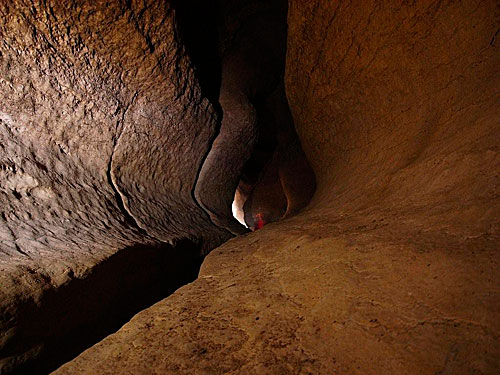
Xanadu Cave.

Glow worms.
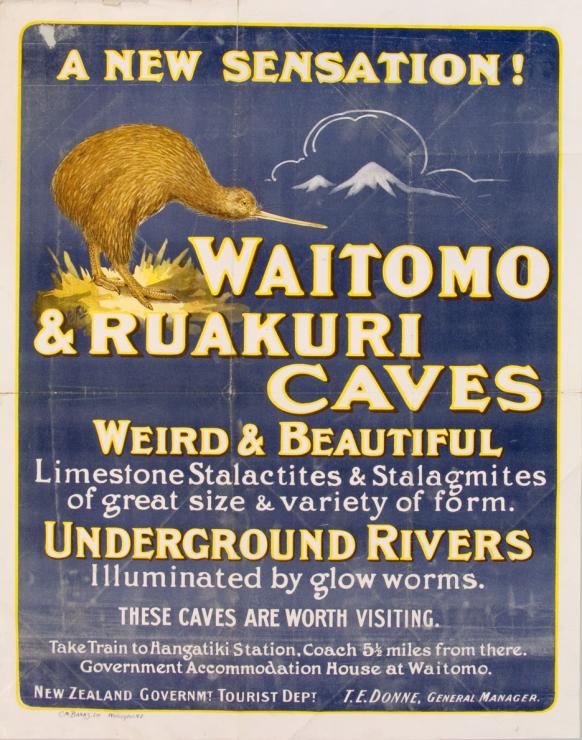
Waitomo Caves.
 The Waitomo Glowworm Caves are unique to New Zealand where thousands of
glowworms (Arachnocampa Luminosa) radiate luminescent light.
The Waitomo Glowworm Caves are unique to New Zealand where thousands of
glowworms (Arachnocampa Luminosa) radiate luminescent light.Muriwai’s cave.
|

Ngāti Awa people trace their ancestry from Toroa, captain of the Mataatua canoe which landed at Whakatāne. Toroa’s sister, Muriwai, was given responsibility for taking the sacred talisman from the canoe and depositing it in this cave.
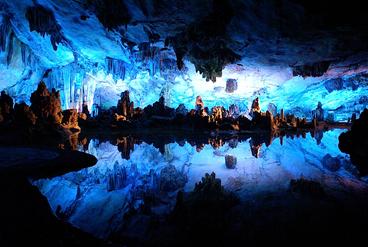
six kilometre long Aurora Cave.
Waitomo Caves is the New Zealand.